


So, you've just gotten a new ferret. If your ferret jumps when you go to touch it (or bites out of surprise when touched from behind or when woken up), has Waardensburg markers, or does not seem to respond to stimuli such as chirping toys which, at the very least, draw most ferret's attention even if only for a second, then you should test the animal for deafness.
TESTING FOR DEAFNESS:
When testing for deafness, it is important test the animal more than once - repeat the test at different times to ensure that you don't get a false positive or negative. Keep in mind that deaf ferrets have learned to cope with deafness and will often follow the lead of ferrets that can hear, so it is best to test your ferret's hearing either on its own or with a deaf ferret to decrease the likelihood of false responses.
HOW TO:
1) When your ferret is not paying attention to you, take a noisemaker - pennies or marbles in a jar work well - and shake it behind the ferret. The ferret, if it can hear, should look at you or dart away and peer our at you from under a couch. Be sure that the ferret does not see you shaking the jar as this may illicit a false response - the ferret will get excited or look at you to see what you are up to.
2) Repeat the test with other noisemakers and at different times. If your ferret is deaf, the response will be the same each time - he or she will continue on with what they are doing (unless they see you shaking a noise maker, at which case they will more than likely see you shaking an object and begin to get excited)
3) Squeaky toys can be used for testing, HOWEVER, be aware that some ferrets that are have Waardensburg syndrome are not stone deaf and may be able to hear certain frequencies. These ferrets should be treated as deaf because, for all intents and purposes, they are. They may be able to hear a squeak, but will not be able to hear you approach them when they are asleep.
Showing posts with label Waardensburg Syndrome. Show all posts
Showing posts with label Waardensburg Syndrome. Show all posts
Friday, March 26, 2010

Friday, June 19, 2009
Deafness in Ferrets: A bit about Waardensburg Syndrome
If you are familiar with ferrets, you have undoubtedly heard that blaze ferrets are more prone to deafness than other ferrets. This is true. The reason behind it is a genetic condition known as Waardensburg Syndrome.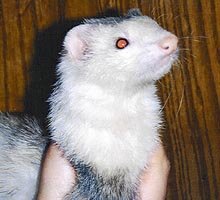 Waardensburg Syndrome results in the underdevelopment of the cochlear of the inner ear, and is found in ferrets with white heads* such as blazes, pandas and DEWs. The same genetic codes that cause the ferret to have a white head can also cause the ferret to be deaf or hard of hearing. This is not to say that ALL ferrets with white heads ARE deaf, simply that they are genetically predisposed to deafness. In other words: ferrets with white heads are not all deaf, but they are MORE likely to be deaf than, say, sable ferrets.
*Albinism is caused by a genetic condition which is entierly different than Waardensburg Syndrome; albinism is not an indication of deafness but, due to the complications with eye development resulting from lack of pigment, albinism in ferrets has been attributed to poor(er) eyesight and potential blindless
Waardensburg Syndrome results in the underdevelopment of the cochlear of the inner ear, and is found in ferrets with white heads* such as blazes, pandas and DEWs. The same genetic codes that cause the ferret to have a white head can also cause the ferret to be deaf or hard of hearing. This is not to say that ALL ferrets with white heads ARE deaf, simply that they are genetically predisposed to deafness. In other words: ferrets with white heads are not all deaf, but they are MORE likely to be deaf than, say, sable ferrets.*Albinism is caused by a genetic condition which is entierly different than Waardensburg Syndrome; albinism is not an indication of deafness but, due to the complications with eye development resulting from lack of pigment, albinism in ferrets has been attributed to poor(er) eyesight and potential blindless
Subscribe to:
Posts (Atom)